Indian MP Raghav Chadha Pushes Crypto & Blockchain Reforms
Indian MP Raghav Chadha urges crypto legalisation, asset tokenisation, and blockchain-based land records, calling blockchain India’s next digital public infrastructure.
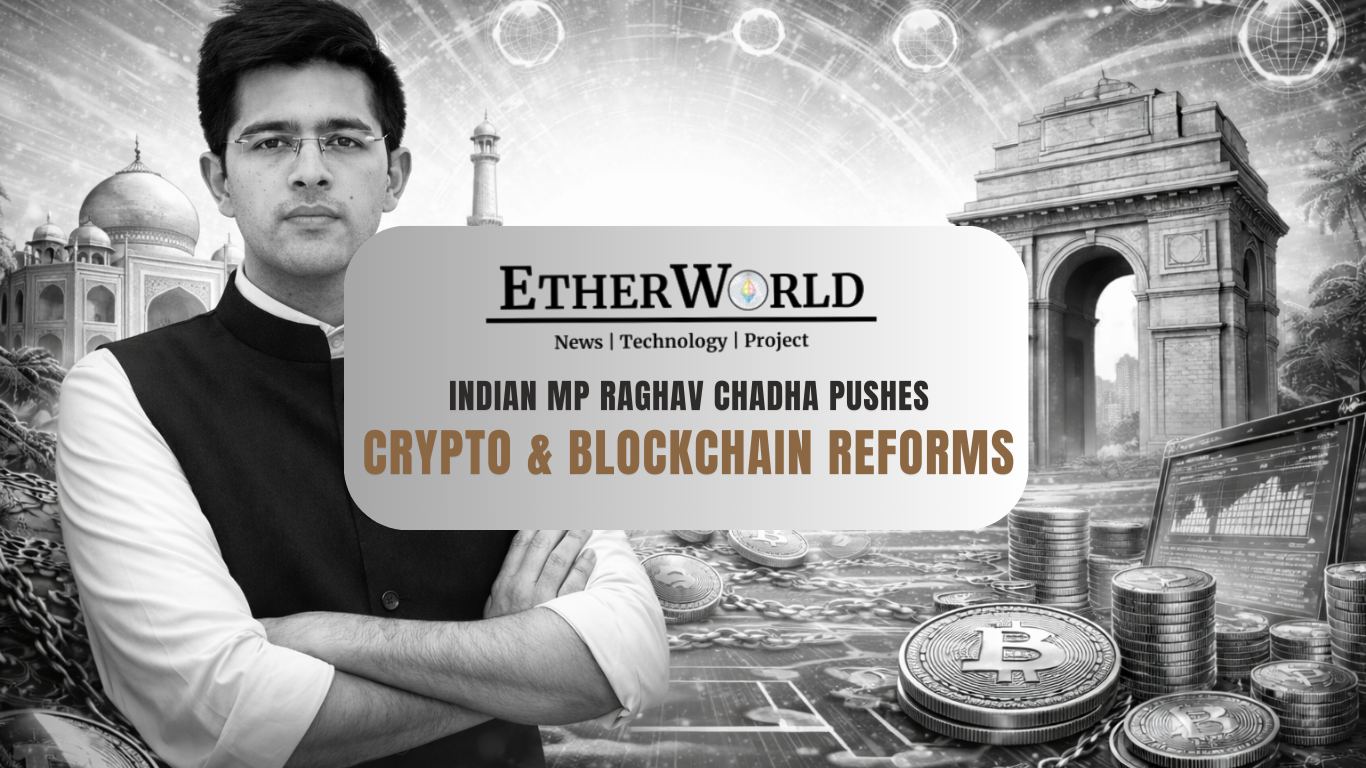
Raghav Chadha, a member of the Rajya Sabha, has urged the Indian government to clearly and systematically legalize cryptocurrencies. Additionally, he recommended that blockchain be used to store all land and property records.
The middle class might profit greatly from asset tokenization and blockchain-based land registries, Chadha clarified during the Rajya Sabha debate on the Appropriation Bill. Property disputes might be reduced and vast sums of underutilized cash may be released, he claimed. His comments have sparked discussion about bitcoin legislation, India's land governance structure, and the wider use of blockchain technology.
The central issue here is whether blockchain technology has the potential to become India's next significant digital public infrastructure (DPI).
- Blockchain Land Records
- Tokenisation Bill Push
- Crypto Legalisation Call
- Global Blockchain Model
- Policy Road Ahead
Blockchain Land Records
One of India's most enduring legal issues is still land conflicts. According to government estimates, about two-thirds of civil court proceedings involve disputes over land and property. Slow, manual verification procedures and dispersed ownership records are largely to blame for this.
The Digital India Land Records Modernization Programme (DILRMP) was launched by the central government in 2016 to address issue. The program's main goals are to digitize Records of Rights, cadastral maps, and state-level registration systems.
According to data made public by the Press Information Bureau, more than 94% of Records of Rights and 68% of cadastral maps nationwide have already been digitalized. Although this is a significant step forward, issues with legality, traceability, and system integration remain.
Here's where blockchain becomes important. Land records management is formally included as a priority proof-of-concept in the Government of India's National Blockchain Framework, which highlights advantages such immutability, tamper protection, and transparent ownership history.
Building on this foundation, Chadha has suggested establishing a national blockchain ledger that would allow for the permanent tracking and auditing of each property transaction.
By integrating blockchain technology into official registry processes, Assam was the first state to explore blockchain-based land registration in the Darrang district.
Tokenisation Bill Push
Chadha presented a more ambitious concept, a Tokenization Bill, that went beyond simple digitization.
By converting tangible assets, such as buildings or real estate, into digital tokens, tokenization enables individuals to possess tiny shares of valuable properties. According to Chadha, tokenization might make real estate investing accessible to everybody, just as UPI made digital payments accessible to all.
He told the Rajya Sabha that illiquid real estate currently holds a significant portion of India's wealth. Tokenization could allow regular people to make tiny investments in high-end real estate or infrastructure projects with the right legal support, generating liquidity while maintaining regulatory protections.
India's National Blockchain Framework already lists asset tokenization as a potential blockchain use case. However, these initiatives are restricted to strictly regulated pilot projects in the absence of appropriate legislation.
Chadha's claim, therefore, is not only theoretical; it seeks legal backing for capacities that the government has previously acknowledged.
Crypto Legalisation Call
Chadha discussed his advocacy for land reforms as well as the continued ambiguity around cryptocurrency legislation. Virtual digital assets in India are subject to a fixed 30% tax rate under the Finance Act 2022, with an extra 1% TDS on each transaction.
However, cryptocurrencies have not yet been officially legalized in spite of this tax structure. Rather, they remain in a gray area of regulation.
Chadha said that this unpredictability is pushing Indian Web3 startups overseas while doing little to safeguard domestic investors. He emphasized that there is a significant policy vacuum when cryptocurrency is taxed without having its legal status properly defined. He called for formal legalization, appropriate safeguards, compliance rules, and incentives that encourage innovation, and he encouraged Parliament to act decisively.
Legalise Virtual Digital Assets (like Crypto, Stablecoin) in India. Don’t drive them offshore.
— Raghav Chadha (@raghav_chadha) February 10, 2026
India taxes VDAs (virtual digital asset) like they are legal. But regulate it like they are illegal.
India taxes cryptocurrency at 30% Capital Gain Tax + 1% TDS; yet offers no legal… pic.twitter.com/Y1JXJLBW85
Global Blockchain Model
Global changes are reflected in the discourse in India. Blockchain-based property transfers have been successfully tested as early as 2019 by Sweden's national land administration, Lantmäteriet. In the meantime, under its virtual asset regulation framework, Dubai has launched government-backed real estate tokenization efforts.
The World Bank has continuously backed blockchain-based land registries in a number of emerging economies as a means of reducing corruption and enhancing the security of property titles.
While formal legislation is still pending, India has taken a more cautious approach, concentrating first on digitization and then testing blockchain trials.
Through the alignment of India's digital infrastructure with international best practices, Chadha's intervention seeks to expedite this process.
Policy Road Ahead
India is at a pivotal point in its history. Most land records are already digital thanks to the Digital India Land Records Modernization Program. There are currently blockchain pilots. There is a tax on cryptocurrency assets. Tokenization of assets is now recognized by policy frameworks. A comprehensive legal structure is still lacking, though.
Chadha is attempting to unite all of these disparate elements into a single, comprehensive reform strategy through his legislative drive, which includes blockchain-based land registries nationwide, crypto regulation, and a specific tokenization bill.
Meanwhile, the price of waiting continues to increase. Courts are still overburdened by property disputes, enormous real estate money is still trapped in illiquid assets, and blockchain talent is fleeing India in search of possibilities overseas. The implementation of these concepts will determine whether blockchain is a brief experiment or India's next significant digital public infrastructure.
If you find any issues in this article or notice missing information, please feel free to reach out at team@etherworld.co for clarifications or updates.
To promote your Web3 articles, events, and projects, you may reach out anytime via EtherWorld PR for submissions and collaboration.
Related Articles
- RBI Proposes Linking BRICS Digital Currencies to Enable Faster Cross-Border Payments
- MetaMask Adds 200+ Tokenized US Stocks & ETFs
- India's FIU Bans Privacy Coins Like Monero & Zcash
- India’s Consultation Paper on Cryptocurrency; RBI DG Statement
- India Spotlighted as BlackRock CEO Larry Fink Calls Tokenization Essential
To follow blockchain news, track Ethereum protocol progress, and read our latest stories, subscribe to our weekly today.
Disclaimer: The information contained in this website is for general informational purposes only. The content provided on this website, including articles, blog posts, opinions, & analysis related to blockchain technology & cryptocurrencies, is not intended as financial or investment advice. The website & its content should not be relied upon for making financial decisions. Read full disclaimer & privacy policy.
To stay updated on blockchain news, Ethereum protocol progress, and our latest stories, subscribe to our weekly digest and YouTube channel for .
To promote your Web3 articles, events, project updates, and Press Releases, reach out anytime via EtherWorld PR for submissions and collaboration. For other queries, email contact@etherworld.co.
If you’d like to support our work, share the content and consider donating at avarch.eth.
Join our community on Discord and
लेखक

Content Writer